Monday, June 9, 2014

When We Were Orphans


Kazuo Ishiguro eases the reader into When We Were Orphans (2000) with beautiful, easygoing and fluid prose. This delightful prose makes the book hard to put down even when it becomes clear that a swindle of some sort occurs towards the end. I came late to the realization that in fact Christopher Banks, the narrator, gives us an unreliable account of his memories; that in fact, he is a hopeless idealist who believed that he could save his parents and possibly, the world. I was strung along and set up for disappointment, not at the book – which I found to be a masterpiece – but at Mr. Banks’s self-possessed idealism and embellished opinion of himself.

Yet, therein lies a masterful portrayal of a character haunted by separation from his parents at an early age. Christopher Banks is a celebrated detective in Britain during the period between the First and Second World Wars. The more celebrated he becomes, the more compelled he feels to solve the one great mystery in his life – the kidnapping of his parents in the International Settlement in Shanghai, China, when he was young.

Ishiguro uses the first person narrative, which serves him great in weaving a story about memory and how unreliable and manipulated (manipulating too) it can be. I missed the first hints of Banks’s embellished memory of himself as he confesses his annoyance at his friend James Osbourne’s comment, “My goodness, you were such an odd bird at school.” His own recollection was that he was not a loner, and that he “blended perfectly into English school life.” These clashing recollections of his childhood give us reason to doubt the accuracy of Banks’s memory and his overstated opinion of himself. Yet this failing is not an end in itself – we find ourselves questioning why he feels the need to do so, and why he feels the need to return to Shanghai to “save” his parents, who in his mind are still being held by kidnappers after so many years, waiting for him to return.

This is why When We Were Orphans is a sad and haunting story. His parents’ disappearance, which had the effect of leaving him “orphaned”, has had a profound effect on him, beginning with his decision to become a detective (he and his friend Akira in their childhood played detectives in quest to find his parents in the first few weeks following their disappearance). Allusions are also made of his obsession in school to become a detective – which, according to his recollection, he tried his best to hide – through his classmates’ comments: “But surely he’s rather too short to be a Sherlock.” Finding his parents becomes his life mission, a revelation that of course comes late in the book:

“My sense is that she is thinking of herself as much as me when she talks of a sense of mission, and the futility of attempting to evade it. Perhaps there are those who are able to go about their lives unfettered by such concerns. But for those like us, our fate is to face the world as orphans, chasing through long years the shadows of vanished parents. There is nothing for it but to try and see through our missions to the end, as best we can, for until we do so, we will be permitted no calm.”

Here Banks speaks of Sarah Hemmings, whom he had feelings for, and who too has a sense of mission in life. But when she realizes that it is “too late” for her, she abandons it and tries to take Banks along in her escape. He nevertheless fails to overcome the need to find his parents, and the latter part of the book reeks of bleak desperation.

I have tried to understand Jennifer’s role in the book to not much success. Perhaps Banks took her in his care to save her from her similar experience of being orphaned. Indeed, he agonizes over leaving her, in his mind another act of abandonment and failing, when he decides to go to Shanghai. A passing reference is made indicating that she attempted suicide following his long absence, perhaps feeling “doubly orphaned.”

In the background of this deeply emotional story are of course broader themes such as the destructive opium trade, colonialism, war, high society, and what Banks saw as prevarications of the elite. A grotesque picture is painted of a party in the International Settlement while Japanese shelling of poorer regions around it is ongoing; each explosion provokes “a few ironic cheers”, comforted by “no chance of any of that coming over here.”

It is, I suppose, difficult writing a sad story without overwhelming the reader with sadness in the prose or the plot. What I like most about this book is its clinical reserve – one isn’t emotionally burdened or drained while reading it. The sadness and haunt inherent in the story are only apparent upon reflection, after which one’s breath is taken away by the masterpiece.

Picture credit: Goodreads

Friday, May 30, 2014

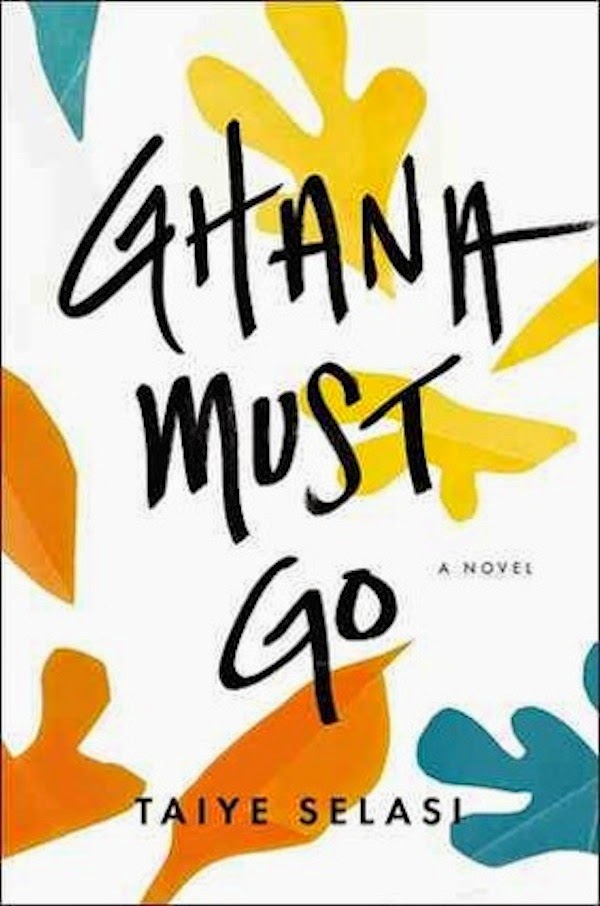
Ghana Must Go


‘Glittering'. ‘Unforgettable’. ‘Stunning’. ‘An astonishing debut’.

These are some of the words, prominent and unmissable on the cover, that goaded me to buy Taiye Selasi’s Ghana Must Go (2013) – who won’t? I proceeded to find a “table for one” in a quiet corner of a restaurant, as I couldn’t wait to get home to start reading it. And I remember my avidity screeching to a halt in a few pages from the start.

I was struck first of all by the beautiful, poetic sentences seemingly not wishing to accommodate idle words in them. Each and every word, it seemed to me, was placed with fastidious care to serve some purpose in the structure of the sentences, to enhance and enrich them with meaning and beauty. Picture this:

“The carpenter... Who built the house in two years working impeccably and alone, smoking hash on the job, rolling blunts during lunch, singing prayers of contrition for any harm done the wood: who came to work in swami clothing (saffron, barefoot, hip-slung tool belt) looking less like a sage than an elderly stripper with his hammer and chisel and bare chiseled thighs: an ancient soul in a younger man’s body with infant eyes in his old man’s face, some seventy odd years old with his cataracts and six-pack…”

At the same time, perhaps to achieve a sustained poetic, maybe even dramatic, effect, Selasi employs a writing style that results in many convoluted sentences loaded with descriptive and narrative meaning. Many passages hence feel overwritten, with many stand-alone phrases laced together by commas. For instance:

“The four quadrants: a nod to symmetry, to his training days, to graph paper, to the compass, perpetual journey/perpetual return, etc., etc., a gray courtyard, not green, polished rock, slabs of slate, treated concrete, a kind of rebuttal to the tropics, to home: so a homeland re-imagined, all the lines clean and straight, nothing lush, soft or verdant.”

The net effect is that one is forced to adjust one’s reading, to slow down and draw on reserves of patience in order to fully understand these passages of prose-poetry. I had to put the book down for a while in exasperation. Yet it is through a combination of these beautiful and overwritten sentences (not forgetting numerous one line paragraphs) that Selasi weaves a rich and deeply emotional story about a family – the Sais. 

The patriarch, Kweku Sai, long having abandoned his family in a moment of shame and perceived failure following an injustice against him, suddenly dies. His family – his beautiful wife Fola, who quit pursuing a career in law to support her husband and raise their family; Olu, his first born son and a brilliant surgeon like him; Taiwo and Kehinde, his beautiful/handsome and talented twins; and Sadie, his last born daughter, who perceives herself as different – scattered in America, London and West Africa, and haunted by their patriarch’s abandonment, are forced together again. What ensues is an emotional journey of self-discovery, forgiveness and renewal of family ties.

Ghana Must Go, a title that derives from the expulsions of Ghanaians from Nigeria in 1983, is not only a story about family; it is also about an immigrant experience (Kweku and Fola, from Ghana and Nigeria, meet in the United States while studying and settle there), fatherhood (Kweku’s abandonment of his family may have been influenced partly by his own father’s act of abandonment), belonging (Fola’s father was Nigerian but she doesn’t feel that she belongs there), and failure – Kweku’s “failure” as well as Fola’s failure as a mother. In the midst of all these themes, Taiye Selasi makes a point against generalizations of the African experiences, that in talking about Africa, the world must take into account specificities.

Arising from the title, Selasi makes use of the word “go” as a motif to denote various meanings. For instance, Kweku’s mother, “plucked from school at age seven to fetch firewood and water”, and “frozen in time pounding yam into paste”, is wistful and, “above all things, wanting to go”, that is, she wanted to get a better life and see the world. Kweku, in his moment of “failure” and giving up, just wants to go – to leave his failure behind. “Go”, “going”, “gone” have therefore been used to imply departure, abandonment, and death (for instance, “[Kweku] is gone”). This twins well with the theme of the immigrant experience – immigration itself is an act of arrival following a departure, a “going” and leaving, as Kweku and Fola themselves confess to each other that their mistakes, perhaps, are in keeping with their identity as immigrants: “We were immigrants. Immigrants leave.”

Ghana Must Go is slow to start. Part I of the book (Gone) is a tough read, partly because of the continuous huffing and puffing of the language, and partly due to the slow revelation of the plot. If you haven’t read it, prepare yourself for endless flashbacks, constant scene setting, and in-depth descriptions of the characters’ emotions, sensitivities and motivations. The book’s speed picks up especially in Part III (Go), and, evidenced also from other reviews I’ve read, it is the part that leaves the longest lasting impression and ultimately saves the book. So if you feel jaded from Part I, don’t give up!

I think the book’s greatest strength is the delicate, sensitive and emotive portraits of the characters – flawed, fallible and ultimately human as they are. Selasi delves inward into their thought processes to lay bare their motivations and feelings in a delicate and sensitive manner. One ends up needing to reach out to Olu, for instance, when he faces “betrayal” from his father; or to Sadie, as she tries to craft out her own identity; but most of all to Taiwo, who is traumatized by what happened in Lagos at his drug dealing uncle’s place – I found that scene awful. If you haven’t read this gem of a book, prepare yourself for deep emotional investments in the characters.

Yet, from purely a subjective, non-literature point of view, I found the book a little too melodramatic. There is too much crying. Seriously. There is too much emotion, a sustained, constant humdrum of melodrama, emotion, and crying. Also, I found it hard believing (despite Selasi’s best efforts, I believe) that Kweku could hide from his wife, for eleven months, that he had been unjustly fired, all the while undertaking a court case against the hospital, and upon failure (again, not his fault – he had the best lawyer, who in fact mentions that Kweku can “practice wherever”) he is crushed enough to abandon his family, leaving them broke, with Fola long having quit her career. I imagine that fiction should possess a realistic measure of believability, unless of course it’s science fiction, fantasy or similar genres.

Nevertheless, Ghana Must Go is an amazing debut work of fiction, a mesmerizing display of great, poetic writing, rich characters, and deeply emotional stories within the story.

Picture credit: Goodreads

Saturday, May 17, 2014

We Are Going


I am currently battling to read Taiye Selasi’s Ghana Must Go. Battling, as it seems to me a long poem disguised as a novel, with its pointed words with pointed meanings, demanding reflection upon each, so that the reading is akin to a morning journey to work in Nairobi traffic – arduous and full of stops and starts, never fluid. One of the motifs I have picked up so far is that of “go” – a simple word that seems to support the entire book. It has been used to imply a departure (but of course), rapture, abandonment, and death; a denotation of departure from a current undesirable state, presumably to a better state of affairs, and sometimes a function of hopelessness, sometimes of escape, and sometimes of desperation. Informed by current circumstances, the act of “going” is one of choice and decision, and thus can be good or bad, voluntary or forced, deliberate or kneejerk; whatever the case, it can offer relief, or can be haunting.

The latest explosions in Nairobi are a pointer to a worsening state of affairs in our beloved country. They happened in spite of a series of measures marked by their desperation and ill conception. Much in the way a dog would chase flea-inflicted itches all over its body, sometimes on far ends as the root of its tail, circling itself furiously, chasing its tail in a futile manner, and finally, frustrated, setting off on a blind trot driven more by the itches than any sense of direction, going, not anywhere in particular but going, escaping but not really escaping, we have become reactionary, driven by stings and kneejerk reactions.

We seem to solve problems but not the root problems; in fact, solving but not really solving. We “solved” the problem of tourist abductions by going for the “root cause”, apparently Kismayu, but forgot to solve the problem of our precarious internal security. Our solution was to go into Somalia, the way university students, inspired by “reincarnations” of Karl Marx, and failing to resolve issues inside the confines of the Campus, decide to go to the streets, responding to war cries of “we go! We go!” Yet the ones we were going after have stripped us naked and very tragically so. Having gone after the enemies, who vanished before our very eyes, we now go after their ghosts and shadows, in our own backyard, resorting to finding bad rice from among millions of good rice and not really finding them.

We discovered ethno-religious profiling, deciding that since the enemies looked like Somalis, we must pick out the bad Somalis from the good Somalis. But then we can’t really tell who is good Somali and who is bad Somali just by looking at them. So we decided to round them up, thousands upon thousands of them, and lock them up in a [concentration] camp. We decided that to be Somali in Nairobi must be a crime, and for Somalis to clear themselves, they must face some sort of humiliation and angst. We imposed a curse upon them, and drew around each and every one of them a halo of danger, a birthright of judgment stamped on their faces, to forever dog them genetically and hence involuntarily. We made sure that this process sends a message – we do not want you, you must go.

We denied reports of children separated from their mothers, of pregnant women giving birth in pools of water and excrement, of our inability to verify national IDs issued by us, and of bribes and corruption. Even when doing something wrong, we can’t do it right.

As we chase ghosts of our enemies, other ghosts, eerie, stalking, and haunting, as sinister as the ghosts we are chasing, are chasing us. It gets better – these ghosts have something to do with the ghosts of our enemies. The ghosts of Anglo-Leasing, perhaps, as we danced with them to private and privileged songs of greed and theft, created a mirage: we postponed resolving the problem we are trying to solve now through the [concentration] camp. These ghosts, having caught up with us, as we tried to escape them but not really escaping them, have forced us to consider them, and to decide that we might, after all, pay them to get them off our backs. That the theft that had been halted can be finalized. That the money must go.

We decide that some people at the State Law Office haven’t done their job right, and decide to come down on them quite hard – we tell them to “up their game”. Perhaps we don’t want to be too harsh on them – they have done quite well in that other big case.

We seem much aggrieved by betrayals of travel advisories, of tourists going, but not as much by the goings of our own people, the permanent goings of death – an insistence perhaps, that tourists must die with us as we grapple and tail-chase and go? That foreign governments must abdicate their national interest of protecting their nationals, wherever they may be? Shouldn’t we know better? (Talking of the advisories, I chanced upon a tweet by a military spokesperson wondering aloud whether they are a result of the Chinese railway deal)

Yet we don’t. We are unable to admit that perhaps our intelligence is poor; or if it’s good, both in-bred and shared, we are unable to use it effectively, perhaps hampered by lack of capacity. We seem to downplay the fact that our police service, maybe the entire security sector, is inadequate to the task. We seem to ignore that a [concentration] camp may in fact radicalize the un-radicalized, and play into the hands of the enemies. Having developed a morbid fascination with tinted windows, we are unable to act on reports of police corruption surfacing all over social media. We fail to admit to ourselves that, perhaps, we need help beyond multibillion-shilling Chinese deals.

Instead, we are preoccupied with chasing shadows and ghosts, with ethno-religious profiling. We have set our minds on this path; no one is going to stop us. We are going

Picture credit: containsmoderateperil.com

Monday, May 5, 2014

Caine Prize Blogathon: My Father's Head


Once in a while one comes across a story possessive of such profound poesy, quiet strength, attention to detail, and a unique portrayal of a character’s feelings that it leaves a long-lasting and magical impression. Okwiri Oduor’s My Father’s Head is one such story (read it here).

Oduor adroitly portrays Simbi’s mourning of her late father in a unique and uncommon way: Simbi attempts to draw her father’s head but finds that she can’t remember how it looked like. That Simbi terribly misses her father is something that starts gnawing at you soon into the story, taking a life of its own and morphing into a palpable feeling of loss.

Told in the first person, My Father’s Head is reflective. Simbi reminisces about her father, recollecting her memories of him. In one of these flashbacks, we see death as something that wasn’t very far off from her father’s, and her own, thinking. To her father, it seemed imminent: “My God, everyone is going. Even me, you shall hear me on the death news very soon.” To Simbi, it was a foreboding thought, an unsettling disquiet about how she will face her father’s death: “I was mourning the image of myself inside the impossible aura of my father’s death.”

When her father died, and even though his death, described in graphic terms (perhaps a graphic content disclaimer should be appended to the story), was horrific, Simbi didn’t weep right away. Her grief is therefore painted as a festering wound that refuses to heal, even after the passage of time: “…what more is there to think of your father, eh? That milk spilled a long time ago, and it has curdled on the ground.”

The story also portrays the sense of belonging as a fleeting one – we feel we belong or people belong to us, when it is not really the case:

“Only the food you have already eaten belongs to you.” “Maybe the day you go back home to your people you will have to sit in a wicker chair on the veranda and smoke alone because, although [your people] may have wanted you back, no one really meant for you to stay.”

In the end, Simbi is able to overcome this debacle when her father returns from the dead (perhaps here the story becomes a fantasy?) – she asks her father to stay.

Oduor’s writing is interspersed with some lovely, dreamily poetic spurts such as this one:

“In the grass, ants devoured a squirming caterpillar. The dog’s nose, a translucent pink doodled with green veins, twitched. Birds raced each other over the frangipani. One tripped over the power line and smashed its head on the moss-covered electricity pole. Wasps flew over the grass. A lizard crawled over the lichen that choked a pile of timber. The dog licked the inside of its arm. A troupe of royal butterfly dancers flitted over a row of lilies, their colourful dancing skirts trembling to the rumble of an inaudible drumbeat…”

With such alive writing, it is easy to see why this story won the Short Story Day Africa’s “Feast, Famine and Potluck” Short Story Competition in 2013, and why it is a strong candidate to win the 2014 Caine Prize for African Writing. Will Okwiri Oduor be the first Kenyan winner since Yvonne Adhiambo Owuor in 2003? Seems highly likely!